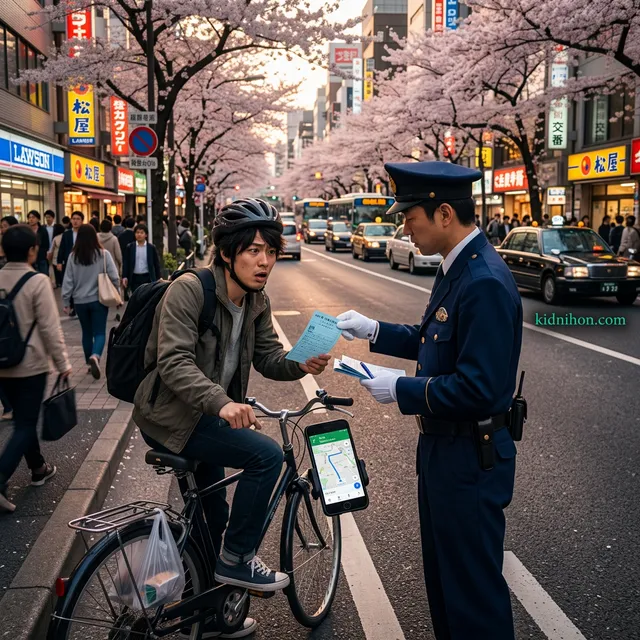
If you ride a bicycle in Japan daily — whether commuting to a part-time job (Baito), shopping at the supermarket, or heading to university — this article is something you absolutely cannot afford to miss before April 1, 2026.
Starting that date, Japan's bicycle traffic enforcement undergoes a seismic shift. Police officers will no longer issue mere verbal warnings. They will now hand you a 青切符 (Ao Kippu — Blue Ticket) on the spot, requiring immediate financial penalty payment.
1. Why Did Japan's Bicycle Laws Change?
According to data from the National Police Agency (警察庁 - Keisatsucho), bicycle-related traffic accidents have been rising consistently over the past five years, especially after the pandemic-era surge in cycling as an alternative to crowded trains.
The top causes identified:
- Cycling while operating a smartphone (accounting for over 40% of all bicycle accidents)
- Running red lights and riding against traffic
- Cycling under the influence of alcohol
The revised law was formally passed by the Japanese Diet in 2024 and takes full effect nationwide on April 1, 2026.
2. Comparison Table: Before vs After April 1, 2026
| Violation | Before April 2026 | From April 2026 |
|---|---|---|
| Phone use while cycling | Usually just a verbal warning | Blue Ticket: 12,000 JPY |
| Running a red light | Rarely enforced | Blue Ticket: 6,000 JPY |
| Wrong-way riding | Verbal warning | Blue Ticket: 6,000 JPY |
| Holding umbrella / earphones | Generally ignored | Blue Ticket: 5,000 JPY |
| Cycling drunk | Occasional arrest | Red Ticket: criminal charge + potential imprisonment |
Key Takeaway: If you've been casually committing these violations without consequences, April 2026 marks a completely new reality. Police have been explicitly instructed to increase enforcement patrols and eliminate all leniency.
3. Each Violation in Detail — With Real-World Examples
🔴 Violation 1: Cycling While Using a Smartphone — Fine: 12,000 JPY
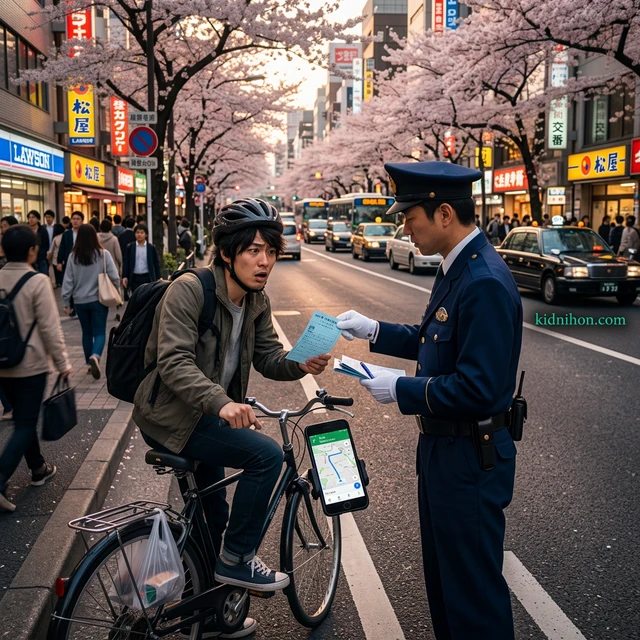
Real-world scenario: You're cycling from your apartment to the nearest train station, phone in hand navigating Google Maps, worried about missing a turn on an unfamiliar route. A police officer stationed at the corner observes this and signals you to stop.
Result: A Blue Ticket worth 12,000 JPY is placed directly in your hands.
Practical solutions:
- Purchase a handlebar smartphone mount (スマホホルダー - Sumaho Holder) available at Daiso, Amazon Japan, or Don Quijote for just 500–1,500 JPY.
- Pre-load your route before departing and place your phone securely in the mount — never hold it.
🔴 Violation 2: Running a Red Light — Fine: 6,000 JPY
Real-world scenario: It's late at night, the road appears completely empty, so you roll through the red light to save time. However, a CCTV camera captures the infraction, or an undercover officer stationed nearby witnesses it.
Note: Japan operates one of the world's densest traffic camera networks. Even without a visible officer, you may receive a penalty notice mailed directly to your registered address.
🔴 Violation 3: Wrong-Way Riding / Incorrect Lane — Fine: 6,000 JPY
Real-world scenario: Many foreign residents habitually ride in the opposite lane because it's more convenient to reach their apartment entrance. This is absolutely prohibited.
Mandatory rule: Cyclists in Japan must ride on the left side (左側通行 - Hidarigawa Tsuko), keeping close to the road edge. Riding against traffic in any direction — regardless of how empty the street appears — is now a fined offense.
🟡 Violation 4: Holding an Umbrella / Wearing Earphones — Fine: 5,000 JPY
Real-world scenarios:
- Raining hard, you hold an umbrella in one hand and steer with the other — instant Blue Ticket territory.
- You're cycling with both AirPods in, completely blocking out external traffic sounds — classified as an obstruction of traffic duty.
Practical solutions: Wear a rain jacket (カッパ - Kappa) instead of holding an umbrella. If you want music, use open-ear headphones that do not isolate environmental sound.
4. Red Tickets (赤切符 - Aka Kippu) — When Does It Become Criminal?
Red Tickets operate in an entirely different category from Blue Tickets. These represent criminal prosecution, creating a criminal record that directly threatens your visa status.
You receive a Red Ticket for:
| Behavior | Punishment |
|---|---|
| Cycling under the influence (酒気帯び運転) | Up to 3 years imprisonment OR fines up to 500,000 JPY |
| Causing a serious accident while cycling | Potential imprisonment up to 7 years |
| Repeated deliberate Blue Ticket violations | Escalated to criminal Red Ticket proceedings |
⚠️ Critical warning for foreign residents: Any criminal record (Red Ticket) causes the Immigration Services Agency of Japan (入国管理局 - Nyukan) to automatically reject your next visa renewal application — regardless of how many years you've lived and worked in Japan.
5. Common Mistakes Made by Foreign Residents
Based on documented real-world experiences from foreign communities throughout Japan, these are the most frequently occurring situations:
Situation 1: Cycling to the supermarket while holding your phone to check your shopping list → Solution: Screenshot or print your list before leaving the house. Keep the phone pocketed.
Situation 2: Finishing a company drinking party (Nomikai) late at night and cycling home → This is the MOST DANGEROUS scenario. Call GO Taxi or walk — never cycle with any alcohol in your system.
Situation 3: Riding the wrong way down a one-way street because it's "just a shortcut" → Take the longer legal route. No shortcut is worth 6,000 JPY and a police stop.
Situation 4: Wearing both AirPods while cycling to enjoy music on your commute → Remove one earbud at minimum, or switch to bone-conduction headphones that preserve environmental sound awareness.
6. Safe & Legal Cycling Checklist for 2026
Before every ride, confirm:
- Phone secured in handlebar mount — not in your hand
- Riding on the left side of the road, close to the edge
- Stopping completely at red lights, behind the pedestrian line
- No umbrella — wearing a rain jacket instead
- Earphones: maximum one ear, never both
- Zero alcohol consumed before cycling
Related Articles
- 5 Crucial Japan Law Changes 2026: Bicycle Fines, Taxes, Pension
- Japan IC Cards 2026: Suica, Pasmo, ICOCA — Complete Guide
- Japan Taxi Guide 2026: GO, Uber, Pricing Rates & Etiquette
- Japan Transportation in 2026: Suica Mobile & Shinkansen
- Choosing a Neighborhood in Tokyo 2026: Ward-by-Ward Guide
Frequently Asked Questions (FAQ)
Q1: How exactly do I pay a Blue Ticket fine after receiving it? A: You'll receive an official payment notice (出頭通知書 - Shutsudo Tsuchisho) containing a bank transfer reference number. Go to any bank, post office, or convenience store with ATM bill payment services and complete the payment before the deadline printed on the form (typically 2–3 weeks). Failing to pay on time escalates the fine amount and results in a formal police summons.
Q2: Do electric bicycles (E-Bikes) fall under the same regulations? A: Yes. Pedal-assist electric bicycles (電動アシスト自転車 - Denodo Assist Jitensha) operating under 24 km/h are legally classified as standard bicycles and must comply with all the above regulations. If an electric bicycle exceeds 24 km/h, it reclassifies as a moped and requires a valid motorcycle license to operate.
Q3: Are children subject to these bicycle fines? A: Blue Tickets apply exclusively to individuals aged 16 and above. However, parents or legal guardians may face civil liability if children under 16 commit serious violations resulting in accidents.
Q4: What additional night-cycling rules should I know about? A: Bicycle headlights (前照灯 - Zensho-to) are legally mandatory when cycling after dark. Riding without illumination constitutes a separate chargeable violation, potentially compounding your total penalty.
✍️ This article was meticulously researched and compiled by the expert verification team at KidNihon. Drop any remaining questions about Japan's 2026 cycling law directly into the comment section below!
Key Takeaways
Always update the latest information from official sources.
Join the community for support when needed.